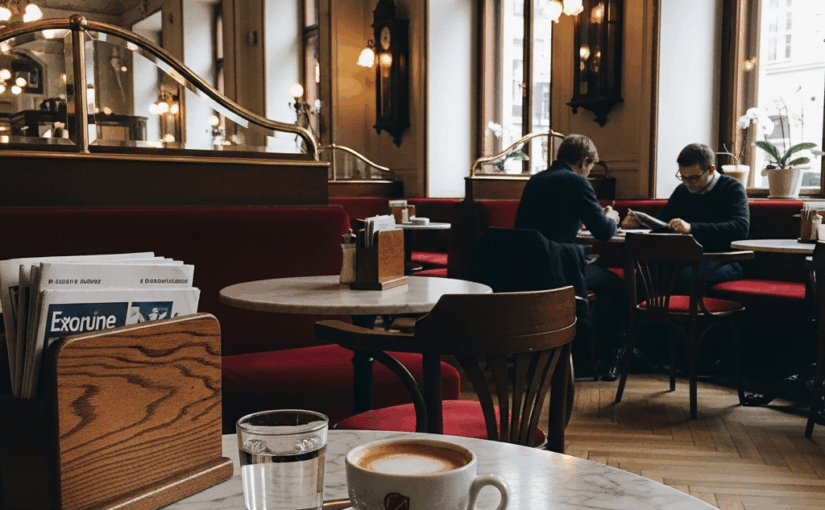
To walk into a traditional Viennese coffee house is to step out of the slipstream of modern time. The air carries the scent of dark-roasted beans and old paper; the marble tables are cool to the touch, and the newspapers adhere to their willow-wood spines just as they have for a century. In a world obsessed with efficiency, these institutions remain steadfast monuments to the luxury of lingering.
As a resident of Vienna, I learned quickly that the Kaffeehaus is not merely a place to acquire caffeine. It is a “second living room”—a description solidified when the Viennese Coffee House Culture was inscribed on the UNESCO Intangible Cultural Heritage list in 2011. UNESCO defines it as a place “where time and space are consumed, but only the coffee is found on the bill.”
If you are looking to understand the soul of this city, you must master the art of sitting still. Here is an authoritative guide to the history, etiquette, and essential destinations of Vienna’s coffee house culture.
The Anatomy of Tradition
Before navigating the city’s specific venues, one must understand what distinguishes an authentic Wiener Kaffeehaus from a contemporary café.
The architecture sets the stage: high ceilings, plush velvet banquettes, cold marble tables, and the iconic Thonet No. 14 bentwood chairs are standard. However, the true distinction lies in the service ritual. A waiter (historically addressed as Herr Ober, though a simple polite eye contact suffices today) will serve your coffee on a silver tray accompanied by a glass of tap water, topped with an upside-down spoon.
This glass of water is significant. Historically, it was meant to cleanse the palate and demonstrate the purity of Vienna’s mountain spring water. More importantly, it signifies your right to the table. As long as that water is there, you are a guest, not a customer, and you will never be rushed—whether you stay for twenty minutes or four hours.
The 10 Traditional Cafés Defining Vienna
Having spent countless hours reading, writing, and observing life in these establishments, I reserve these ten spots for those seeking the most authentic, historically significant experiences.
1. Café Central: The Cathedral of Coffee
District: 1st (Innere Stadt) | Notable Patrons: Peter Altenberg, Sigmund Freud, Leo Trotsky
Located within the palatial Palais Ferstel, Café Central is the grand dame of Viennese coffee culture. With its soaring vaulted ceilings and ecclesiastical atmosphere, it feels like a cathedral dedicated to conversation. Opened in 1876, it became the intellectual hub of Fin de siècle Vienna. It is said that Leon Trotsky planned the Russian Revolution over chess here, while the poet Peter Altenberg listed the café as his home address.
Insight: The line for a table can be long. Go on a weekday at 9:00 AM to admire the architecture in peace. The life-sized mannequin of Altenberg by the entrance remains a stoic guardian of the café’s literary past.
2. Café Sacher: Imperial Indulgence
District: 1st (Innere Stadt) | Famous For: Original Sacher-Torte
Opposite the Vienna State Opera, Café Sacher radiates the opulence of the Habsburg monarchy. While it attracts tourists worldwide for its signature Sacher-Torte—a dense chocolate cake with a thin layer of apricot jam, created in 1832—the establishment remains a bastion of high-end service.
Insight: Order the torte “mit Schlag” (with unsweetened whipped cream). The dryness of the cake is intentional, designed to be balanced by the moisture of the cream and the bitterness of a Melange.
3. Café Sperl: The Cinematic Time Capsule
District: 6th (Mariahilf) | Atmosphere: Unchanged since 1880
If Café Central is the showpiece, Café Sperl is the authentic heart. Little has changed here in over 140 years. The velvet booths are worn just enough to be comforting, and the billiard tables in the back add a rhythmic click-clack to the ambient noise. It is famously featured in the film Before Sunrise, perfectly capturing its role as a place for intimate, wandering conversation.
Insight: Sperl is less about grandeur and more about Gemütlichkeit (coziness). It is the ideal spot for Sunday morning newspaper reading.
4. Café Hawelka: The Artists’ Den
District: 1st (Innere Stadt) | Vibe: Bohemian, dimly lit, energetic
Founded by Leopold and Josefine Hawelka shortly after World War II, this café became the living room for Vienna’s post-war avant-garde. Unlike the marble-clad palaces, Hawelka is dark, slightly smoky (in spirit, if not reality), and plastered with art left behind by struggling painters who used sketches to pay their tabs.
Insight: Visit after 10:00 PM. This is when fresh Buchteln (sweet yeast buns filled with plum jam) come out of the oven. They are a culinary institution in themselves.
5. Café Landtmann: The Seat of Power
District: 1st (Innere Stadt) | Notable Patrons: Sigmund Freud, Gustav Mahler, Marlene Dietrich
Located on the Ringstraße near the Burgtheater and City Hall, Café Landtmann is the embodiment of bourgeois elegance. Sigmund Freud was a regular; today, it is the preferred haunt of politicians and journalists conducting off-the-record interviews. The interior is classic Biedermeier—refined wood paneling and spacious booths.
Insight: The menu here is more substantial than most, effectively bridging the gap between coffee house and fine dining. The Wiener Schnitzel is exemplary.
6. Café Prückel: Mid-Century Modernism
District: 1st (Innere Stadt) | Design: 1950s renovation by Oswald Haerdtl
While most guides focus on the 19th century, Café Prückel offers a stunning glimpse into post-war Viennese modernism. Refurbished in the 1950s, its pastel colors, clean lines, and oversized windows create a bright, airy contrast to the darker traditional cafés. It sits opposite the Museum of Applied Arts (MAK), attracting a design-conscious crowd.
Insight: Prückel actively encourages lingering. It is one of the best spots for students and writers who need natural light.
7. Café Schwarzenberg: The Ringstraße Icon
District: 1st (Innere Stadt) | History: Oldest remaining café on the Ring
Opened in 1861, Schwarzenberg was the first café on the famous Ringstraße boulevard. It retains a heavy, masculine elegance with dark wood, brass, and bevelled mirrors. Unlike many inner-city cafés that have pivoted entirely to tourism, Schwarzenberg retains a loyal local following, particularly for business breakfasts.
Insight: The view from the window tables looks out onto the bustling Ringstraße, allowing you to watch the modern world rush by while you remain suspended in the 19th century.
8. Café Museum: The Minimalist Revolution
District: 1st (Innere Stadt) | Architect: Adolf Loos
When Adolf Loos designed this space in 1899, he stripped away the plush velvet and stucco common to the era, earning it the nickname “Café Nihilismus.” It was a radical architectural statement prioritizing function over ornamentation. High-profile regulars like painters Gustav Klimt and Egon Schiele appreciated the stark modernity.
Insight: Following a masterful renovation that restored Loos’s original vision, it is now a calm, bright space perfect for reading.
9. Kleines Café: The Hidden Gem
District: 1st (Innere Stadt) | Vibe: Intimate and local
True to its name (“Small Café”), this tiny spot on Franziskanerplatz was designed by architect Hermann Czech in the 1970s but feels timeless. It is barely larger than a living room, forcing a communal intimacy that is rare in the larger halls. In summer, the seating spills out onto the cobblestone square, creating one of the most picturesque settings in Vienna.
Insight: There is no grand menu here. The coffee is strong, the bread with chives (Schnittlauchbrot) is fresh, and the atmosphere is resolutely bohemian.
10. Café Bräunerhof: The Literary Hideout
District: 1st (Innere Stadt) | Notable Patron: Thomas Bernhard
Hidden on a side street near the Hofburg Palace, Bräunerhof was the preferred refuge of the misanthropic writer Thomas Bernhard. The café prides itself on one of the largest selections of international newspapers in the city. The interior suggests a faded grandeur that refuses to apologize for its age.
Insight: On weekends, a small chamber orchestra often plays live waltzes. It is less polished than those at Café Central, which makes it feel infinitely more authentic.
Deciphering the Menu: What to Order
Ordering a generic “coffee” in Vienna is a faux pas. The menu requires specificity:
- Melange: The standard. A shot of espresso lengthened with hot water, topped with steamed milk and milk foam. Similar to a cappuccino, but using a milder, Viennese roast.
- Kleiner/Großer Brauner: A small or large espresso served with a separate tiny pitcher of coffee cream (Obers), allowing you to titrate the milk yourself.
- Einspänner: A double espresso served in a glass, topped with a towering dollop of cold whipped cream (Schlagobers). Originally designed for carriage drivers (Einspänner means one-horse carriage) to keep the coffee warm while they held the reins.
- Verlängerter: An espresso “lengthened” with an equal amount of hot water (akin to an Americano), usually served with milk on the side.
- Obermayer: A double espresso with a thin film of cold cream poured over the back of a spoon.
Etiquette: The Unwritten Rules
To blend in with the locals—or at least avoid the ire of the waiter—observe these norms:
- Take a Seat: Unless there is a “Please Wait to be Seated” sign (common in tourist-heavy spots like Central or Sacher), you are generally free to choose any empty table.
- Formal Greetings: Acknowledge the staff with a “Grüß Gott” upon arrival. When ready to pay, verify the total with the waiter and add roughly 10% as a tip; tell them the total amount you wish to pay, rather than leaving cash on the table.
- The Newspaper Rack: You are encouraged to take newspapers from the wooden racks and bring them to your table. Return them when finished; hoarding papers you aren’t reading is considered rude.
- Digital Detention: While laptops are tolerated in some cafés (Prückel, Landtmann), they are frowned upon in quieter, smaller venues. The coffee house is a space for conversation and contemplation, not conference calls.
The Cultural Imperative
Vienna’s coffee houses arose as democratic spaces during the Habsburg monarchy—places where aristocrats, intellectuals, and tradesmen shared the same room. Today, they serve a vital function in an increasingly digital world. They act as a “third place,” neither work nor home, where we are permitted to disconnect.
When you settle into a booth at Café Sperl or Landtmann, realize that the price of your Melange covers more than the beans and milk. It functions as rent for a sanctuary of slowness. In the silence of these rooms, surrounded by the murmur of history, Vienna offers its greatest luxury: the permission to simply be.